
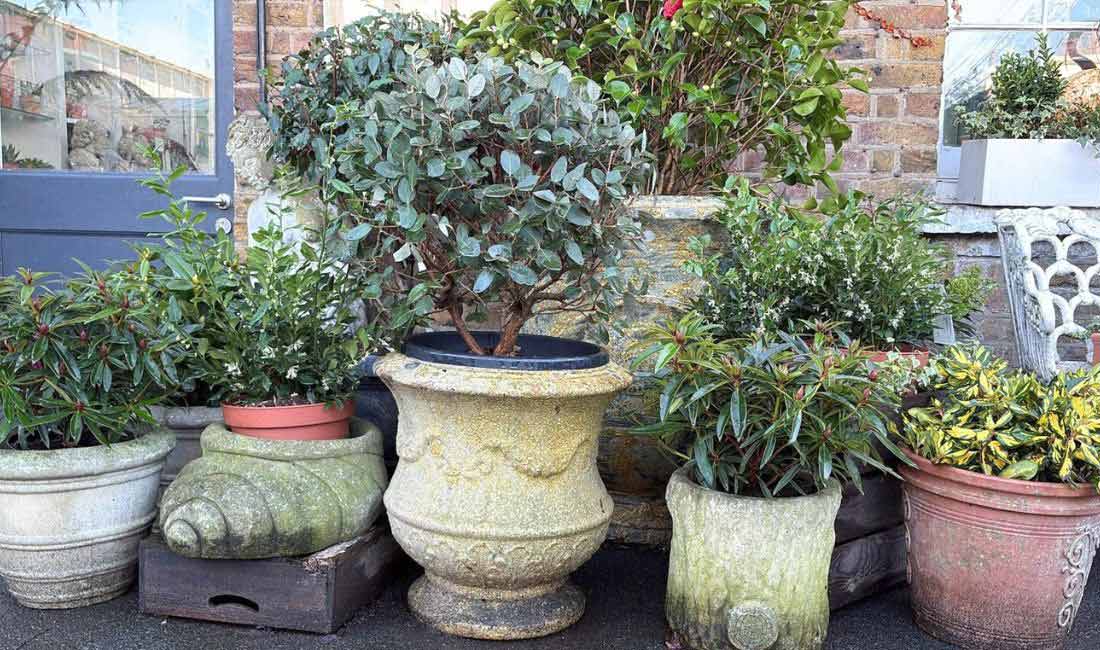
In an urban area with relatively smaller gardens than in rural areas, and with many balconies, patios and roof gardens, container gardening offers immense potential to enjoy creating your own garden style by positioning plants in a wide range of locations.
Pots and planters are ideal, not just for putting plants in, but also for adding your own special touch to your outdoor space including using some planters as sculptural pieces.
Garden pots and planters are available in a wide range of:
Different materials according to your garden style and budget
Different shapes according to your garden style, purpose of the pots and the type of plants to go into them
We invite you to visit our London nursery where you’ll see that we’re definitely a bit potty about pots!
Types of Garden Pots
Plastic
Lightweight, durable and often budget friendly, plastic pots do have many advantages. Thin-walled cheaper pots are ideal for short term planting such as while plants increase in size. Stronger containers in heavy-duty plastic are available in a wide range of colours and sizes, ideal for adding style to the garden as well as fun. The stronger plastic pots, such as our Elho range, have the benefit of being frost proof and long lasting. Plastic pots benefit from not cracking if dropped or knocked over - and are ideal for balconies and roof gardens due to being lighter in weight than many other types of garden containers.
Clay Terracotta
Popular for many gardeners, clay terracotta pots come in numerous shapes sizes and are not only traditionally attractive but also have the benefit of being a breathable material, meaning that the compost in the pot is less likely to overheat in summer or become waterlogged in winter than the compost in a waterproof container.
Although clay pots may need watering more in summer due to being porous and some of the cheaper ones may be prone to frost damage in very cold areas, their only main disadvantage is that they will crack if you drop them!
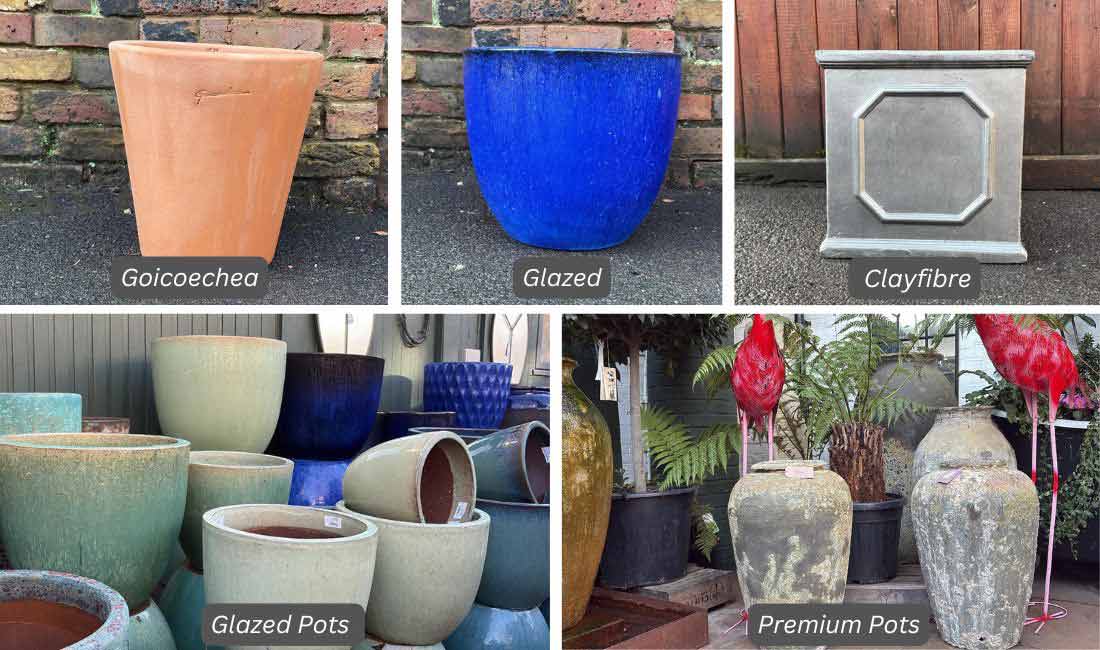
Clay terracotta pots at the cheaper end of the range are machine made but those of a higher quality, such as our beautifully elegant range of Goicoechea pots and planters, are handmade in France, frost proof and much sought after for their style and durability.
Glazed
Glazed clay and earthenware pots have the benefits of coming in a range of, often bright, colours with the glaze making them more frost tolerant than simple clay pots. In addition, the glaze makes the clay less porous so they may need watering less in the summer than unglazed clay pots.
Clayfibre
Clayfibre and polyfibre pots are lightweight, durable planters made from a blend of clay, fibreglass, and recycled fibres. They have the benefit of looking similar to stone or terracotta, but are much lighter and easier to move - making them particularly practical for balconies and roof gardens and also for growing plants that need moving in the winter for protection.
Premium Pots
Made from a mixture of materials, to a unique and secret recipe, and woodfired with a glaze that gives each piece a totally unique hue and character, Clifton Nurseries are one of the few stockists for a select range of premium pots – the sort of pots and planters that are sculptural pieces in their own right, as well as being suited as planters. Solid, heavy, and frost proof these special planters need to be seen!
Vintage
Available in a wide range of materials and styles, pre-loved vintage pots are not only eco-friendly in terms of reuse but are ideal for adding that unique touch to your garden – providing something that the neighbours definitely can’t copy!
Shapes of Garden Pots
Just like the well known and very useful guideline ‘right plants, right place’, so too is there a very useful guideline for pots and planters of ‘right shape, right size, right plants’.
Regular Plant Pots
Regular freestanding pots are commonly round but also available as square shapes, as well as other options.
Round pots are often considered to provide a softer, more traditional look and their shape promotes even water and nutrient flow for the root systems, while also enabling easy replanting and potting up. Square pots maximize space by fitting snugly, offer more soil volume for root growth, and provide better stability. However, as the benefits of one over the other are fairly small, we encourage personal preference – after all, it’s your garden space and you’re the one who’s going to be using it! And likewise, while some may wish to have all their pots matching in at least style, if not in size, others may go for a total mix – the choice is yours. One of the benefits of container gardening is that it’s not for ever, so there’s always scope for changing it according to your preferences!
If you’re planning on planting large plants (or plants that potentially grow large) in containers, the size of container is crucial in determining the success of the planting. We do recommend asking our friendly team for advice as well as using our professional planting teams to do the necessary hard work for you!
Troughs / Window Boxes
Popular in urban areas, window boxes are for some, their version of a mini garden and rectangular window boxes are the most practical shape. Likewise for narrow balconies, troughs are ideal. Just remember to always check the weight bearing capacity of window box fittings or balconies before deciding on which type of window boxes and troughs you’d like!
Recycling Items as Garden Pots
As often seen in our plant displays at our London nursery, plants can be grown in containers other than those initially designed for growing plants outdoors. Whether they’re vintage or modern, pre-loved and vintage or new, other items such as sinks, chimney pots, wheel barrows and buckets are ideal for adding that unique personal style to your garden. Be creative and enjoy the fun of container gardening!
Top Tips for Planting Containers
Planting techniques do differ slightly according to the type of pot and plant, but there are some essential rules that should always be followed:
Ensure that the container has drainage holes to avoid the roots rotting from sitting in water. If possible, raise the pot onto bricks or pot feet to ensure the drainage doesn’t get blocked. If you place the pots on saucers in the summer to save water, ensure that you remove the saucers for the winter.
If planting long-term, larger plants such as shrubs and small trees, you may wish to put a drainage layer of pebbles or bricks at the bottom of the pot to improve drainage and to help prevent the pot blowing over.
Use the right compost according to what you are planting; soil-based compost for long term planting, ericaceous compost for acid loving plants, and compost with added grit for succulents and cacti.
All plants grown in containers will need feeding and watering much more than plants grown in the ground.
When the roots of a pot fill up the pot and the plant is starting to become pot-bound, pot up the plant into a slightly bigger size. Avoid the temptation to pot up into a much bigger size as the roots will then be sitting in soggy compost and may rot. Alternatively, to reuse the same size of pot, extract the plant from the pot in the winter when it is dormant, remove some of the old compost and trim away some of the plant roots (but not more than 25%), and then repot with fresh compost in the same pot.
Clifton Nurseries Garden Centre
London, W9 2PH
0207 432 1867
Monday – Saturday 9am-5:30pm, Sunday 10.30am-4.30pm
Clifton Nurseries Garden Services
London, W9 2PX